
فارسی
Behsoshafa logo

When Is a Soft Cast the Better Choice? Semi-Rigid Immobilization Protocols

Introduction

A soft cast cures semi-rigid, preserving slight flexibility while providing supportive immobilization. It suits scenarios where full rigidity isn’t necessary and controlled motion plus easier skin/edema monitoring are desired. Below are practical indications, decision criteria, and semi-rigid protocols.
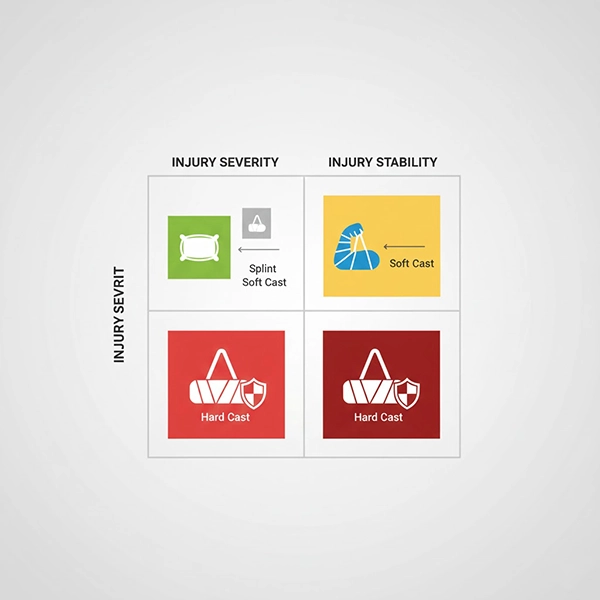
Clinical decision chart to choose soft cast vs hard cast vs splint based on injury stability and severity

When to choose a soft cast—key indications

  • Mild–moderate ligament sprains (ankle/wrist) benefiting from functional immobilization.
  • Post-acute transition after a splint once swelling subsides.
  • Step-down after hard cast removal to prevent stiffness and enable graded motion.
  • Pediatrics and athletes prioritizing comfort, breathability, and low weight.
  • Stable injuries with low displacement risk under clinical supervision.

When a soft cast is not appropriate

  • Unstable/displacing fractures requiring full immobilization.
  • Low adherence or high-risk behaviors that demand rigid protection.
  • Acute neurovascular/compartment concerns—manage emergently first.

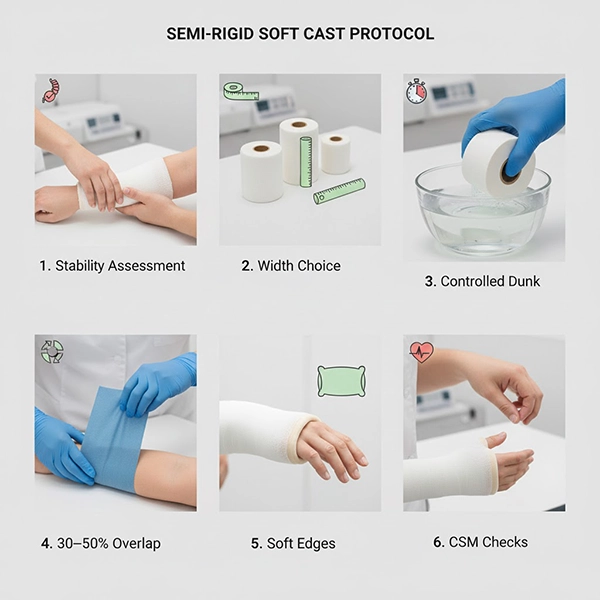
Operational flow for semi-rigid soft cast protocol: stability assessment, width choice, layup, CSM checks, and follow-up

Semi-rigid immobilization protocol—soft cast

  1. Stability assessment: exam + initial imaging + displacement risk.
  2. Width/length: 7.5 cm for wrist/ankle; 7.5–10 cm for forearm/calf; 3.6–4.6 m length.
  3. Controlled activation: lukewarm water (≈20–25 °C), 2–5 s dunk, gentle squeeze.
  4. Standard layup: 30–50% overlap, even tension; reinforce bony prominences.
  5. Soft edge finish: moleskin/fabric tape to minimize edge pressure/dermatitis.
  6. Cool-air drying: avoid direct heat; then reassess CSM.

Follow-up protocol

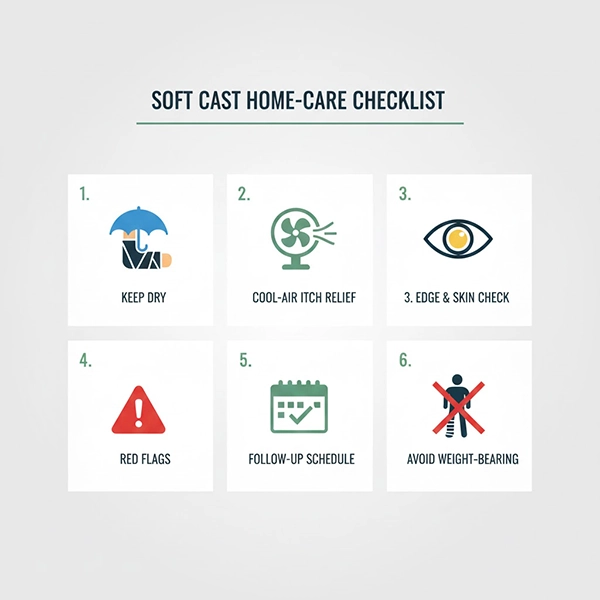
  • First review at 3–7 days: pain/edema/edge comfort and fit.
  • Imaging: leverage radiolucency to check alignment without removal.
  • Red flags education: escalating pain, numbness, odor/discharge, color change ⇒ urgent review.
  • Rehab plan: progressive ROM under physiotherapy guidance.

Soft vs hard cast vs splint—selection logic

  • Hard cast: maximal stability but heavier and less forgiving.
  • Splint: adjustable for acute swelling and quick removal.
  • Soft cast: middle ground—sufficient stability with comfort and breathability.

Patient care

  • Keep dry; use cool air for itch; no objects under the cast.
  • Follow activity restrictions; avoid impacts and risky motion.
  • Inspect edges/skin and report any irritation.

Home-care checklist for a soft cast: keep dry, cool-air itch control, red flag awareness, and follow-up timing

Conclusion & CTA

When clinical stability aligns with the need for comfort, breathability, and graded rehab, a soft cast offers the best balance. For tailored protocols and staff training, please contact our team.