
فارسی
Behsoshafa logo

What Is a Soft Cast? Definition, Benefits, and Differences vs Hard Cast & Splint

Introduction

A soft cast is a water-activated fiberglass immobilization system that, unlike a hard cast, retains a small degree of flexibility after setting. It is ideal for low-to-moderate injuries, transitional rehab phases, and functional immobilization when skin monitoring and comfort matter.
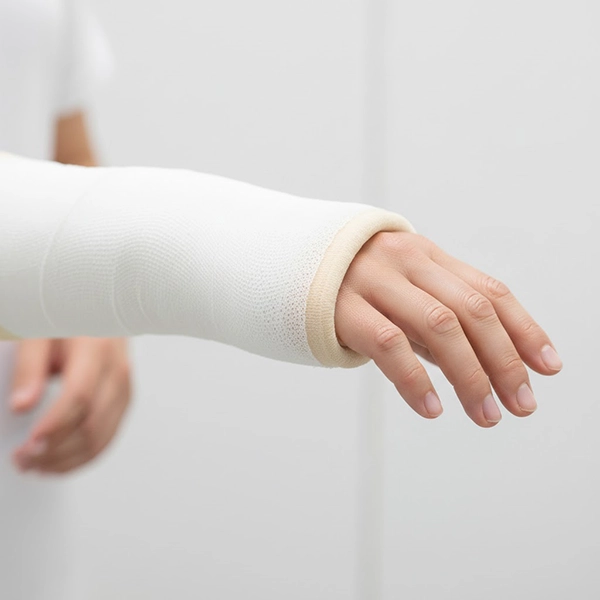

Close-up of a fiberglass soft cast on the wrist showing gently flexible edges

What exactly is a soft cast?

It uses fiberglass casting tape with a tuned resin so the shell cures semi-flexible. Compared with a fully rigid hard cast, soft casts allow limited, safe motion while maintaining supportive immobilization. Padding and soft edge finishing reduce pressure dermatitis.
When to choose a soft cast

  • Ligament sprains (wrist/ankle) not requiring strict rigidity.
  • Post-splint transition once swelling subsides, enabling controlled motion.
  • Rehab after hard cast removal as a step-down device.
  • Pediatrics/athletes where comfort and light weight are crucial.

Benefits vs a hard cast

  • Lighter, more comfortable: fiberglass is light; edge flexibility improves tolerance.
  • Imaging-friendly: better radiolucency eases follow-up without removal.
  • Breathability: porosity helps reduce itch/odor.
  • Easier removal: typically simpler than many hard-cast builds.

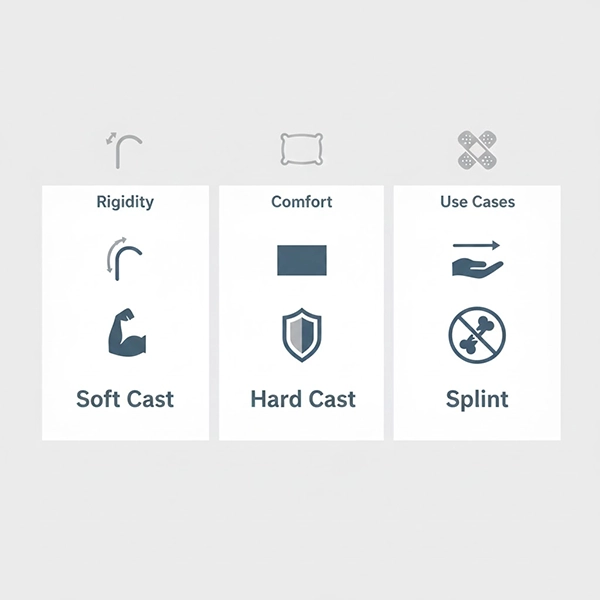
Practical comparison chart between soft cast, hard cast, and splint for rigidity, comfort, and clinical use

Soft cast vs hard cast vs splint—key differences

  • Hard cast: fully rigid; best for unstable fractures or when absolute immobilization is required.
  • Splint: adjustable immobilization (often with Velcro) for acute swelling or quick removal.
  • Soft cast: in-between; stable yet slightly forgiving for functional, step-down phases.

Technical notes for building a soft cast

  1. Width/length: 7.5 cm for wrist; 7.5–10 cm for forearm/calf; 3.6–4.6 m length.
  2. Lukewarm water: 2–5 s dunk; 30–50% overlap with even tension.
  3. Soft edge finish: add moleskin to reduce edge pressure.
  4. Cool-air drying: avoid direct heat to reduce exotherm and dermatitis.

Patient-centered care

  • Keep the cast dry; use cool air for itch relief; no sharp objects inside.
  • Escalating pain, numbness, odor/discharge, color changes ⇒ urgent review.
  • Adhere to rehab protocols; soft casts support controlled motion, not risky activity.

Conclusion & CTA

A soft cast bridges splints and hard casts—stable enough yet comfortable for daily life. Explore sizes/specs of Optima Cast and Vian Cast on our product page.