
فارسی
Behsoshafa logo

Veterinary Uses of Fiberglass Casts: Selection & Techniques

In veterinary practice, fiberglass casting tapes outperform plaster of Paris for many indications thanks to lighter weight, higher strength, better breathability, and radiographic clarity. From small-animal fracture immobilization to post-op support, outcomes depend on correct tape width/length, padding choice, and a consistent layup technique. This guide summarizes selection, preparation, and application steps for dogs and cats.


Clinical application of a fiberglass cast to a dog's forelimb supported by a veterinary technician

1) Proper Selection: Width, Length & Stiffness

  • Tape width: 5 cm for small feline/puppy limbs, 7.5 cm for medium, 10 cm for large; proper width improves contour control and reduces pressure ridges.
  • Roll length: plan 3–4 rolls for a medium forelimb/hindlimb depending on segment coverage.
  • Set window: target gel time ~2–4 min and handling-free ~5–8 min for reliable molding.

2) Preparation: Alignment, Padding & Skin/Hair Protection

  • Alignment: gentle traction and reduction where feasible; confirm perfusion and toe movement.
  • Undercast padding: even layers with extra protection over bony prominences (carpus, tarsus, olecranon).
  • Edge finishing: soften edges with moleskin to limit hair/skin abrasion.

Selecting proper padding and adjunct splints for small-animal casting

3) Layup Technique & Molding

  • Water activation: single dip in lukewarm water; gently express excess—avoid prolonged soaking.
  • Overlap: 30–50% with gentle, even tension; avoid peaks/valleys.
  • Molding: maintain limb contour during gel window; consider adjunct external splints for active animals.
  • Joint inclusion: immobilize the joint above and below for fractures; tailor range limits for supportive casts.

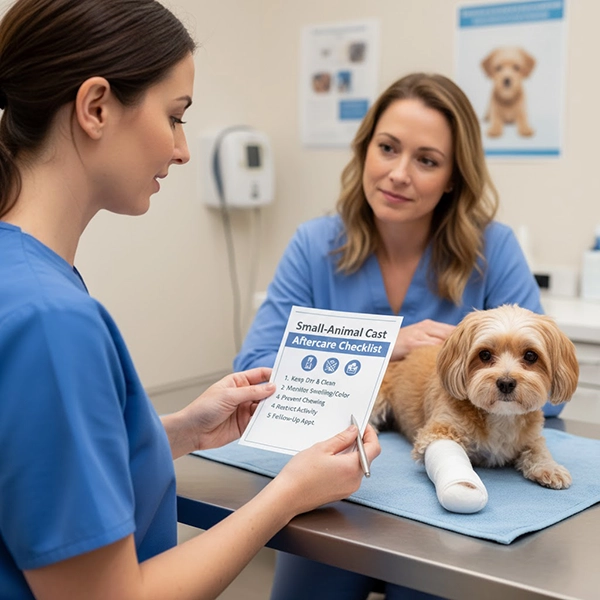
4) Post-Casting Care

  • Keep dry/clean: prevent wetting/mud; if damp, blot and use cool air.
  • Owner monitoring: watch for odor, swelling proximal/distal to cast, discoloration/cold toes, or persistent licking.
  • Behavioral protection: E-collar to prevent chewing; leash/crate restriction as needed.
  • Follow-ups: scheduled skin checks and radiographs; adjust/replace if loose or cracked.

5) Red Flags & Complication Management

  • Escalating pain, unusual restlessness, or cast intolerance
  • Marked swelling, discharge, foul odor, or soft spots on the cast
  • Cold/discolored distal limb, sudden paresis, or numbness
  • Loose, cracked, or waterlogged casts

Small-animal cast aftercare checklist reviewed before discharge from the clinic

Conclusion & CTA

Correct tape selection, standardized padding, and disciplined layup significantly improve immobilization quality and patient welfare. To explore veterinary fiberglass cast tapes in multiple widths and lengths, visit our product page.