Clinical Casting Guide for Common Fractures (Wrist, Forearm, Ankle)
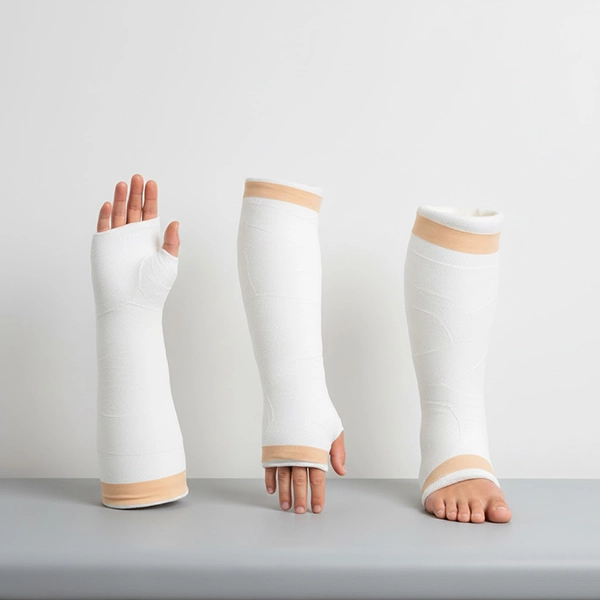
This practical guide walks through fiberglass casting for three common injuries—wrist (distal radius), forearm (radius/ulna), and ankle—with emphasis on width/length selection, 30–50% overlap, uniform padding, soft edge finishing, radiolucent imaging follow-up, and patient comfort.

Pre-casting essentials
- Size selection: 7.5 cm for wrist/ankle; 7.5–10 cm for forearm/calf. Typical length 3.6–4.6 m.
- Uniform padding: reinforce bony prominences; avoid wrinkles.
- Activation water: lukewarm; consider shorter rolls in hot/humid climates.
- Soft edges: moleskin/fabric tape to reduce pressure dermatitis and pseudo-shadows.
1) Wrist—Distal Radius (Short Arm Cast/Thumb-Free)
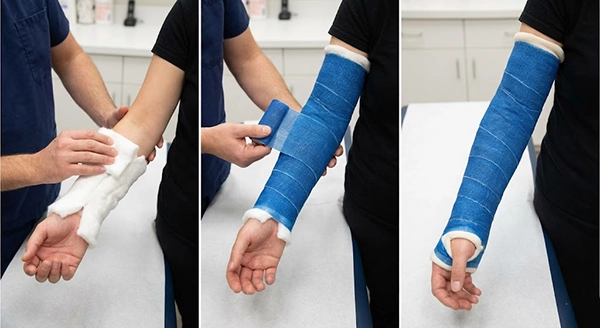
Indication: stable distal radius fractures after closed reduction. Suggested size: 7.5 cm (5 cm for thumb maneuvering), 1 roll 3.6–4.6 m. Position: neutral or slight extension; mild ulnar deviation per provider plan.
- Initial splint: sugar-tong or posterior splint during swelling; convert to full cast later.
- Padding: reinforce radial/ulnar styloids and dorsal wrist; preserve thumb freedom if planned.
- Layup: 30–50% overlap with even tension; avoid steps at wrist crease.
- Edges & CSM: soft finish; reassess color/sensation/motion of digits.
Imaging follow-up for wrist casts
- Fiberglass radiolucency enables clear alignment/callus checks without cast removal.
- Escalating pain, numbness, odor/discharge ⇒ prompt review.
2) Forearm (Radius/Ulna)—Long Arm Cast
Indication: stable forearm fractures after reduction and clinical decision. Suggested size: 7.5–10 cm; 1–2 rolls depending on stature and reinforcement needs. Position: elbow at 90°, forearm rotation per plan (pronation/supination/neutral).
- Padding: reinforce epicondyles, olecranon, and dorsal forearm; avoid pressure points.
- Layup: progress from arm to hand with uniform overlap; keep the posterior elbow free of folds.
- Modularity: switching 7.5 → 10 cm mid-build improves efficiency and rigidity.
- CSM check: immediately post-cast and pre-discharge.
3) Ankle—Short Leg Cast
Indication: selected stable ankle/talus/metatarsal injuries post-reduction. Suggested size: 7.5 cm around malleoli; 10 cm up the calf; 1–2 rolls. Position: neutral ankle (no varus/valgus, no extreme dorsiflexion/plantarflexion).
- Padding: reinforce medial/lateral malleoli and heel; remove wrinkles.
- Layup: narrow width around the ankle, wider up the calf.
- Edge finishing: soften to protect the Achilles region and shoe edge contact.
- Foot coverage: through metatarsophalangeal joints; toes visible for perfusion checks.
Skin safety & comfort—common to all
- No objects under the cast; cool-air drying for itch relief.
- Keep edges clean/dry; avoid creams/sprays under the cast.
- Red flags (pain ↑, numbness, odor/discharge, color change) ⇒ urgent review.
Frequent errors & quick fixes
- Creases at flexion points: reopen and re-mold before full set; or local trim and correction.
- Edge pressure: add moleskin and round the edges.
- Overuse of material: pick appropriate width/length; shorter rolls improve set-time control.
Conclusion & CTA
With correct sizing, uniform padding, standard overlap, and soft edge finishing, fiberglass casts provide stable immobilization and imaging-friendly follow-up for wrist, forearm, and ankle injuries. For staff training and case-specific advice, please contact our team.